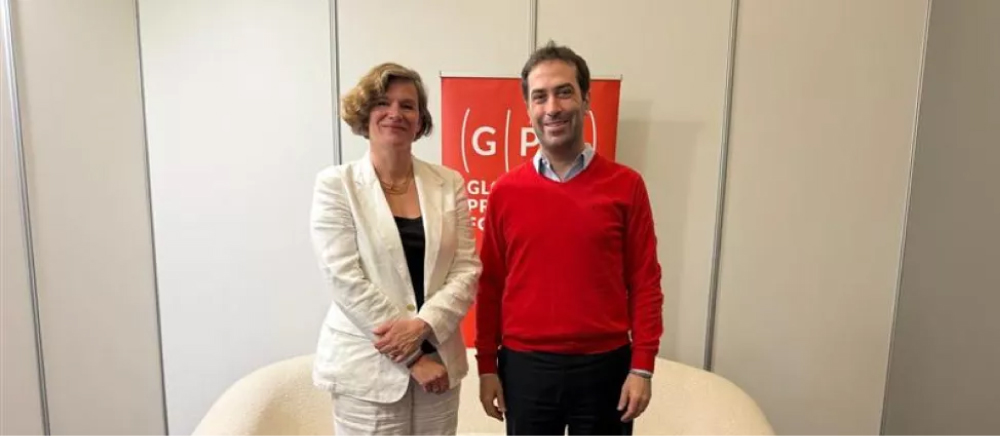
Barcelona, 18 April 2026—Professor Mariana Mazzucato and Carlos Cuerpo, Spain’s First Deputy Prime Minister and Minister of Economy, Trade and Business, today launched the Global Council on New Economics for the 21st Century in Barcelona. The Council will bring together a group of internationally leading economists to challenge the cross-cutting assumptions in economic theory and modelling that constrain progress on the biggest issues of our time, and to set out updated economic principles with practical implications for policy design, institutional practice, and multilateral reform.
Across the world, economic orthodoxies have failed to deliver opportunity, security, and dignity for the majority. For decades, a narrow set of assumptions — that markets self-correct, that governments should stand back, that growth will trickle down — have been treated not as theories but as facts. They have shaped how budgets are designed, how institutions are evaluated, and what counts as responsible governance. The consequences are visible everywhere: housing that working families cannot afford, public servicesstretched to breaking point, and a climate transition that stalls because it is treated as a cost rather than an investment. Meanwhile, reactionary forces exploit these failures, spreading misinformation and stoking fear to threaten the hard-won rights of the last century.
Yet the evidence increasingly shows that a different approach works. Where progressive governments have directed public investment with purpose, structured labour markets to provide security, and treated the green transition as anopportunity rather than a burden, the results speak for themselves: stronger growth, more stable employment, expanded renewables, a strengthened welfare state, and a sounder fiscal position. These outcomes are not achieved despite progressive economic policy, but because of it.
The Council proposes an intervention at the level of economic thinking itself. Important work has been led by commissions and high-level panels on specific issues, including tax, inequality, debt, climate, water, biodiversity, and health. The Council complements these efforts by addressing the cross-cutting assumptions that constrain progress across all of them, while learning from and scaling positive examples of progressive economic policy already at work.
The Council’s work is organised around the common good — not as a slogan but as an operational framework thatreshapes economies work in the first place: who they serve, what they reward, and whose voice counts. The Council’s conceptual framework draws on Mazzucato’s forthcoming book, The Common Good Economy: a new compass (2026). It rests on four interdependent principles: justice, equality, sustainability, and global solidarity. Its inquiry will cover eight cross-cutting areas of economic thinking from what we value and measure, to how finance serves the economy, what fiscal responsibility actually requires, what state capabilities must be rebuilt, in whose interests does governance serve, how should value be created and shared to reduce inequality from the start, whose lived experience counts in policy design, and how to harness the power of technology and AI for the common good.
The Council will be co-chaired by Professor Mazzucato and Minister Cuerpo, with the UCL Institute for Innovation and Public Purpose (IIPP) as its main academic partner and the Government of Spain as inaugural host. Its membership, drawn from leading economists across the Global North and South, will be announced in due course. Finance ministers, senior policymakers, labourrepresentatives, and communities will be engaged throughout the inquiry, grounding it in lived outcomes.
The Council will hold its first meeting in summer 2026 and convene in person on the sidelines of key global events,including the World Bank–IMF Annual Meetings and COP. A second in-person meeting is planned for Madrid in spring 2027, with updated economic principles and an associated reform agenda to be finalised by autumn 2027.
Professor Mariana Mazzucato, Founding Director of the UCL Institute for Innovation and Public Purpose and Co-Chair of the Global Council on New Economics for the 21st Century, said:
“For decades, a narrow set of assumptions — that markets self-correct, that governments should stand back, that growth will trickle down — have been treated not as theories but as facts. They have shaped budgets, hollowed out institutions, and constrained governments that sought to govern differently. This Council proposes an intervention at the level of economic thinking itself. The common good is not a slogan — it is an operational framework for reshaping how markets work in the first place: who they serve, what they reward, and whose voice counts.”
Deputy Prime Minister of Spain, Carlos Cuerpo, welcomed Spain’s hosting of the Council:
“Spain provides a compelling example that economic growth and modernisation can be pursued alongside environmental, fiscal, and social responsibility. We are proud to be hosting this Global Council, and we will bebringing precisely this perspective to the table, contributing to a broader reflection on how competitiveness, sustainability, and social cohesion can be understood as mutually reinforcing pillars of a more resilient and forward-looking economic model.”
The full concept note laying out the purpose of the Global Council on New Economics for the 21st Century and its areas of inquiry is available here.
Launch Event at Global Progressive Mobilisation, Barcelona on 18th April 2026
Video: Agora Ernest Lluch: Reclaiming the Economy – Green Industrial Policy Beyond Neoliberalism
Speakers: Prof Mariana Mazzucato, Prof Isabella Weber, Manuel de la Rocha Vázquez, Deputy First Miniter Carlos Cuerpo, and Dario Carnevalli Durigan
Description: Prof. Mariana Mazzucato discusses how green industrial policy can move economies beyond neoliberalism, arguing for an active, mission‑oriented role of the state in driving sustainable and inclusive growth.